Treat or Remove: Mature Ash Decisions in Longmont CO
Longmont's mature ash trees are some of the most valuable shade assets in the city—wide canopies, established root systems, decades of growth. But since emerald ash borer arrived in Boulder County, every ash owner in Longmont faces the same uncomfortable question: do you treat, or do you remove? Neither answer is automatically right. The correct decision depends on the tree's size, health, location, and how the cost math plays out over time. This article walks through the factors that actually matter so you can make a defensible decision before the beetle makes it for you.
Why the Treat-or-Remove Question Is Harder Than It Looks
On the surface, the choice seems binary. In practice, it sits on a spectrum. A healthy 18-inch ash in a visible front yard is a different calculation than a 30-inch ash leaning toward a fence line with a hollow basal section. Treatment is not a permanent cure—it is a recurring commitment. Removal is a one-time cost but eliminates decades of canopy value. Getting this wrong either direction costs real money.
Longmont homeowners also face a local wrinkle: ash trees here grow fast and large because of Front Range soils and irrigation patterns. That means higher removal costs when trees are neglected too long, and a higher canopy replacement cost if you remove prematurely. The financial stakes are meaningful on both sides.
The Cost Math Behind Annual Treatment
Soil-injected systemic insecticides—primarily emamectin benzoate or imidacloprid—are the standard treatment tools for emerald ash borer. Cost is driven primarily by trunk diameter. A 20-inch diameter ash treated with emamectin benzoate typically runs between $150 and $250 per treatment cycle. Emamectin provides two-year protection, so the annualized cost lands around $75 to $125 per year. Imidacloprid is less expensive upfront but requires annual application and is considered less effective on heavily infested trees.
Over ten years, a well-maintained treatment program on a moderately sized ash costs roughly $750 to $1,250. Over twenty years—the effective remaining lifespan of a healthy mid-sized ash—that number climbs to $1,500 to $2,500. For a specimen-grade tree with strong structure, excellent placement, and no significant defects, those numbers are usually easy to justify. For a tree in marginal condition, they deserve scrutiny.
When Treatment Still Makes Sense
Treatment is defensible when the tree meets a threshold of conditions. The canopy should retain at least 30 percent of its original density—trees with more than 50 percent canopy dieback are rarely recoverable even with aggressive treatment. The trunk should show no significant structural defects: no large co-dominant stems with included bark, no advanced decay at the base, no major root damage from construction or drought stress.
Location matters too. Ash trees in Longmont's older neighborhoods—especially near Roosevelt Park or along the established residential streets north of Main—often provide genuine cooling value for nearby structures. A well-placed ash on the southwest corner of a lot can reduce air conditioning loads measurably. That functional value stacks on top of the aesthetic and property value arguments for treatment.
For Emerald Ash Borer Treatment to remain effective long-term, the tree needs to be structurally sound enough to distribute the systemic chemical through its vascular tissue. A tree with significant deadwood or girdling damage may not move the treatment effectively even when it is applied correctly.
When Removal Makes More Economic Sense
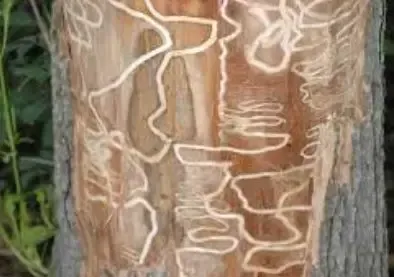
Several conditions shift the math decisively toward removal. Advanced infestation is the most common. Once emerald ash borer larvae have completed multiple generations in a tree, the S-shaped galleries beneath the bark disrupt water and nutrient movement so severely that recovery becomes unlikely regardless of chemical intervention. If you notice heavy woodpecker activity—birds excavating bark in search of larvae—that is often a sign the infestation is further along than the exterior suggests.
Pre-existing structural problems compound the issue. An ash tree with a significant crack, a major wound that has failed to compartmentalize, or a compromised root system due to previous construction work is a liability whether or not EAB is present. Adding an infestation to a structurally compromised tree accelerates the decline and elevates the removal complexity and cost.
Size and placement also affect removal economics. A very large ash—say 36 inches or more in diameter—near a structure in Longmont can cost $2,500 to $5,000 or more to remove, particularly if crane access or precision rigging is required. But that cost is still finite. Paying $400 to $600 annually to treat the same tree when it has less than a decade of viable life remaining produces a worse long-term outcome.
The Timing Problem Most Homeowners Underestimate
One of the most common mistakes in Longmont is waiting too long to make this decision. Treatment must begin before infestation reaches a critical threshold—ideally before any visible symptoms appear, or in early infestation when canopy loss is under 20 percent. Once a tree crosses into moderate or severe decline, treatment efficacy drops sharply and removal becomes more complex and expensive because the wood is deteriorating, branches are brittle, and the tree presents a higher hazard during the removal process.
You can read more on eab quarantine in Longmont to understand how movement restrictions affect your options for wood disposal and replanting timelines. Quarantine rules have practical implications for what happens after removal, including where wood can be transported and whether you need a certified arborist to document the work.
What a Professional Assessment Actually Covers
A qualified arborist evaluating a Longmont ash tree for treat-or-remove should look at trunk diameter and overall size, current canopy density and dieback percentage, evidence of current EAB activity such as D-shaped exit holes or serpentine galleries, structural integrity including root flare condition and any trunk defects, and site value including proximity to structures and access constraints for future removal.
That assessment should produce a clear recommendation with a rationale tied to the specific tree—not a generic suggestion to treat everything or remove everything. Ask directly: given this tree's condition and my projected costs, what is the expected value of treatment over the next ten years versus removing and replanting now?
Replanting as Part of the Decision
If removal is the right call, Longmont's urban canopy suffers when replacement planting is skipped. The city has made investments in street tree programs along certain corridors, but private yard trees lost to EAB represent a long-term cooling and ecological deficit that only replanting can address. Species diversity is important—monoculture plantings of any single species create exactly the vulnerability that made the ash borer outbreak so damaging in the first place.
Consider replacing with native or climate-adapted species that perform well in Boulder County conditions: bur oak, chinkapin oak, hackberry, or frontier elm are all viable alternatives that provide meaningful canopy within 10 to 15 years and carry far less disease and pest risk than ash did at comparable maturity.
Making the Call With Confidence
There is no universal right answer to the treat-or-remove question for Longmont's ash trees, but there is a right process. Evaluate the tree's health honestly. Run the cost math over a realistic timeframe. Factor in location and structural condition. Get a professional assessment from someone who will give you a specific recommendation rather than a hedge. The worst outcome is deferring the decision until the tree deteriorates to the point where removal is dangerous, expensive, and the only remaining option.
